-

How to pray in Islam (Beginners Guide)
A step-by-step beginner's guide to learning how to pray in islam. Watch the full video here:
-
-
Islamic Research Team-Department of Fatwa-State of Kuwait.
A Beneficial Summary of Rulings for New Muslim
A Beneficial Summary of Rulings for New Muslim is a comprehensive book for the new Muslim discussing the basics of Islamic beliefs and practices.
-
NewMuslimGuide
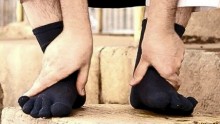
Wiping over Khuffs leather socks and socks
Wiping over Khuffs (leather socks) and socks. When a person wears socks or Khuffs, he may wipe over them during ablution, without washing the feet, with the following conditions: 1-Putting them on after entering a state of complete purification, with no minor or major impurity, and after washing his feet. 2-The socks or Khuffs should be pure, not touched by impurity. 3-The wiping should occur within the permissible time limit. 4-The socks or Khuffs should be lawfully earned, not stolen or seized by force. ''Khuffs'' are footwear made of thin leather; the same ruling applies to shoes that cover feet. ''Socks'' are footwear made of fabric and the like.
-
NewMuslimGuide
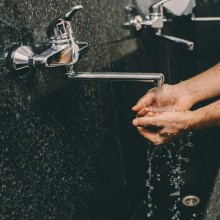
How to make Ablution (Wudu') and it's Importance
Wudu' (Minor Ablution) Allah Almighty says: ''Indeed, Allah loves those who are constantly repentant and loves those who purify themselves.'' [Qur'an Chapter 2, Verse 222] The Prophet (peace be upon him) said: “Perform ablution similar to my ablution.” Because of the immense status of Salah (prayer), Allah prescribed purification before salah and made purification a condition for the validity of prayer. It is the key to prayer (the first step towards performing it). The consciousness of its merit makes the heart long to perform prayer. The Prophet (peace be upon him) said: "Purification is half of Imān… and prayer is light." He (peace be upon him) also said: "He who performs the Wudu’ perfectly, his sins come out from his body.” Thus, a Muslim stands before his Lord in a state of physical purification through ablution and spiritual purification through performing this act of worship sincerely to Allah Almighty and in compliance with the guidance of the Prophet (Allah’s prayers and peace be upon him). What are the acts of worship for which ablution is obligatory? 1- The prayer whether mandatory or supererogatory. 2- Circumambulating the Ka‘bah (Tawāf). 3- Touching the Mus-haf (a bound copy of the Qur’an). Perform ablution (Wudu') and ritual bath (Ghusl) with purifying water. Purifying water is any water that falls from the sky or springs from the earth and remains in its original state without a change to any of its three characteristics: color, taste, and smell; by one of them the state of purity of water is interrupted.
-
GuideToIslam
How to perform wudu' (ablution)? (a complete guide of wudu')
#Wudu' is one of the great rites of #Islam. It is a means of purification from #sins and misdeeds. Muslims will be summoned on the Day of Resurrection with white faces, hands and feet due to the marks of wudu'. The prayer of a capable #believer is not valid except with wudu'. One of the greatest concerns of a believer is to learn and teach the acts of worship, because upon them depends his happiness in this worldly life and in the hereafter. In this clip, there is a detailed explanation of how to perform wudu'. We hope the viewer benefits from watching it.

-
GuideToIslam
How to pray (Salah) Prayer? (A complete guide of prayer)
Salah, which Muslims perform five times a day is an obligation upon every capable believer. It should not be neglected as long as the person has the ability to perform it. A Muslim is required to establish the prayer even if they are tired, busy, or have just awakened from sleep. Salat for Muslims is like a mother’s warm embrace that a young child resorts to whenever something frightens him, a source of comfort and peace to which the believer turns whenever fear, worry, or hardship arises. It is the most important act of worship that a Muslim should strive to learn, preserve and teach, as it is the foundation of faith and the key to success in both this life and the hereafter. In this video, you can find a clear and detailed guide on how to perform salah from #Takbir to #Taslim. We ask Allah Almighty to benefit everyone who watches it.

-
GuideToIslam
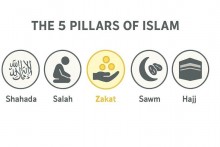
The five pillars of Islam
The Five Pillars of Islam are the foundation upon which the faith of a Muslim is built. Islam is like a strong structure supported by five pillars; if one pillar is weakened or neglected, the stability of the whole structure is affected. These pillars represent the core acts of worship and belief that every Muslim is required to learn, understand, and practice. They shape a Muslim’s relationship with Allah and guide their daily life with purpose, discipline, and faith. In this video, you will be introduced to the Five Pillars of Islam in a clear and simple manner, helping you understand their importance and encouraging you to learn them and pass this knowledge on to future generations.
-

-
GuideToIslam
How To Clean From Ritual Impurity
New Muslims Class Level 1 - Lesson 21: How To Clean From Ritual Impurity.
-
NewMuslimGuide
Learn Surah Al-Fatiha (Pronunciation Of The Letters)
How to correctly pronounce Al-Fatiha , the first surah of the Holy Qur'an.
-
NewMuslimGuide
Learn How To Pray (A Practical Guide for Beginners)
Allah ordained upon the Muslim five prayers in the day and night; they are : 1- Fajr (dawn) prayer. 2- Dhuhr (noon) prayer. 3- ‘Asr (afternoon) prayer. 4- Maghrib (sunset) prayer. 5- 'Isha’ (night) prayer. Prepare yourself for Prayer (Salah). When the time of prayer starts, the Muslim purifies himself from the state of minor impurity, and major impurity if he is in a state of major impurity. Major impurity is what requires Ghusl (ritual bath). Minor impurity is what requires Wudu’ (ablution). The Muslim prays in a clean place free of impurities, wearing clean clothes that conceal his ‘Awra (body parts that must be covered during prayer). A Muslim wears proper clothing which covers his body in prayer. A man is not allowed to pray with the area between his navel and knees uncovered and the woman must cover her whole body in prayer except for her face and hands. While performing Salah, the Muslim only says the words relevant to Salah, he listens to the Imam (the person leading the congregational prayer), and he does not turn left or right in Salah. If he is unable to memorize the words of Salah, he should mention Allah and glorify Him (by saying 'Subhān Allah') until the prayer ends. He is required to hasten to learn Salah and its words.
-
Osoul Global Center
The Six fundamentals of faith
A Muslim moves in life, including tests and struggles, as a vehicle that walks in ways which differ in roughness and ease. Just as this vehicle needs solid pillars to overcome all the difficulties, the heart of the Muslim can not be strong enough to reach the pleasure of his creator and enter the paradise except with believing in these six fundamentals.. In this clip we learn the six fundamentals of faith to establish our certainty, and live our lives in their light.

-
Fahd Salem Bahammam
The Six Pillars of Faith
This is a gift for all the new Muslims who currently know the right path to Allah. This is a means to strength and preserve their belief. In these audios Sheikh Fahd Salem Bahammam shows the fruits of becoming a Muslim, the excellent features of Islam and all aspects of Islam. Sheikh Fahd illustrates the pillars of faith on which one’s belief is based and the pillars of Islam which contain the best practical deeds (e.g. prayer) and the best deeds of the heart i.e. the monotheism. As Islam is a social religion, Sheikh explains the Muslim’s behavior towards all individuals in the society, old or young, whether they embrace Islam or not. Afterwards he puts up some notice about both of the permissible and prohibited financial dealings. He also mentions the factors which increase the one’s belief and help the Muslim to abide by Allah’s commands. He refers to the obstacles (e.g. lust, misconception and ignorance) in the path of the Muslims prevent him from continuing his way to Allah. He also shows the prerequisites of the sincere repentance which is between the person and his God without a mediator. Finally, he gives a word for the new Muslim.

-
Haya Muhammad Eid
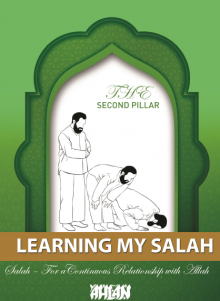
Learning My Salah
Salah is the cornerstone of Islam and its second pillar. A person’s Islam is incomplete unless they perform Salah.
-
Jamaal al-Din Zarabozo
A guide for the new Muslim
This is a gift for all the new Muslims who currently know the right path to Allah. This is a means to strength and preserve their belief. In this book Sheikh Jamaal al-Din Zarabozo shows the fruits of becoming a Muslim, the excellent features of Islam and all aspects of Islam.
-
GuideToIslam
The pillars of Islam
It is the time to believe in Islam, worship Allah the only true God, follow the Messenger of Mercy, the Prophet Muhammad peace be upon him, believe in the Quran the book of miracles.
-
E-Da`wah Committee
A Brief Guide to Ramadan and Fasting
Fasting throughout Ramadan is the fourth of the five pillars of Islam. Therefore, it is obligatory for each adult, sane, responsible Muslim to observe fasting throughout Ramadan.
-
Al-Ahsa Islamic Center
I Embraced Islam Recently... Please Teach Me
This book guides the new Muslim to the Islamic issues s/he should learn immediately
-
AbdulRahman Bin Abdulkarim Al-Sheha
My first steps in Islam
In order to become a Muslim, there are no specific religious rituals or customs that you need to perform, neither in specific areas nor in front of people.